Have you ever stopped everything just to stare at a rainbow after a rainstorm? That beautiful arc of rainbow colors in the sky feels almost magical, doesn’t it? It is like nature’s way of painting a smile across the clouds. Rainbows have fascinated people for thousands of years, appearing in stories, art, songs, and even as symbols of hope and good luck.
When we talk about rainbow colors, most people think of the classic seven: red, orange, yellow, green, blue, indigo, and violet. You might remember them from school with the fun acronym ROYGBIV (pronounced “Roy G. Biv”). These colors aren’t random, as they come from sunlight breaking apart into its different parts.
This guide is your one-stop spot for everything about rainbow colors. We will keep things simple and fun, like chatting with a friend who is really into cool science facts. We will cover how rainbows form; the exact order of the colors and why it is that way; the history behind how we decided on seven colors; the rare types of rainbows that you have probably never seen, myths from around the world, and even how these rainbow colors show up in design and everyday life today.
By the end of the post, you will know more about rainbow colors than most people, and you will have tips to spot or even make your own rainbow at home. Let’s dive in!
Note: Some of the images used in this post may have been digitally altered for illustrative purposes
AI Prompt Idea for a Stunning Header Image:
Generate an abstract swirl of rainbow colors that feels energetic and fluid. This would make a great colorful addition for your blog post/article!
What Are the Rainbow Colors? The Standard Order Explained
Let’s start with the basics: What exactly are the rainbow colors, and why are they always in the same order?
A typical rainbow shows seven main colors, from the outside of the arc to the inside:
1) Red – The top or outer band.
2) Orange
3) Yellow
4) Green
5) Blue
6) Indigo (a deep blue-purple)
7) Violet (also called purple) – The bottom or inner band.
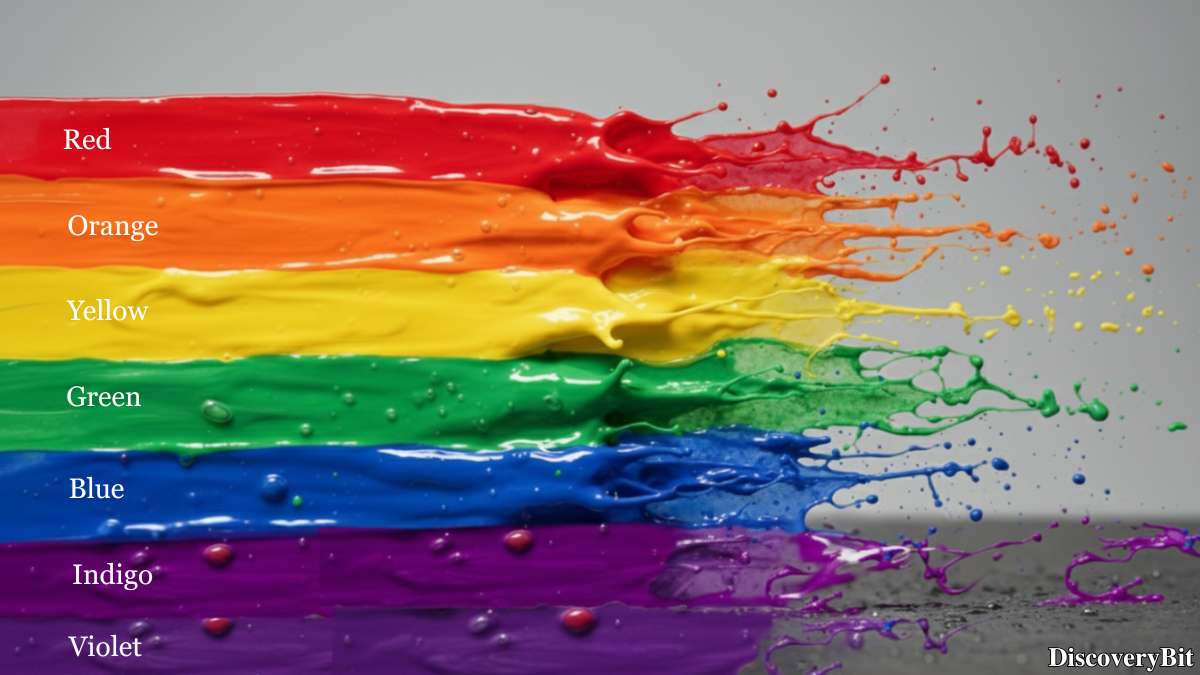
The order never changes because it is based on how light behaves. Sunlight looks white to us, but it is actually made up of all these colors mixed together. When light passes through water droplets (like after rain), it splits into these colors, kind of like a prism separating light.
The colors appear in this order because each one has a different wavelength (think of it as the “size” of the light wave). Red has the longest waves, so it bends the least and ends up on the outside. Violet has the shortest waves, so it bends more and ends up on the inside.
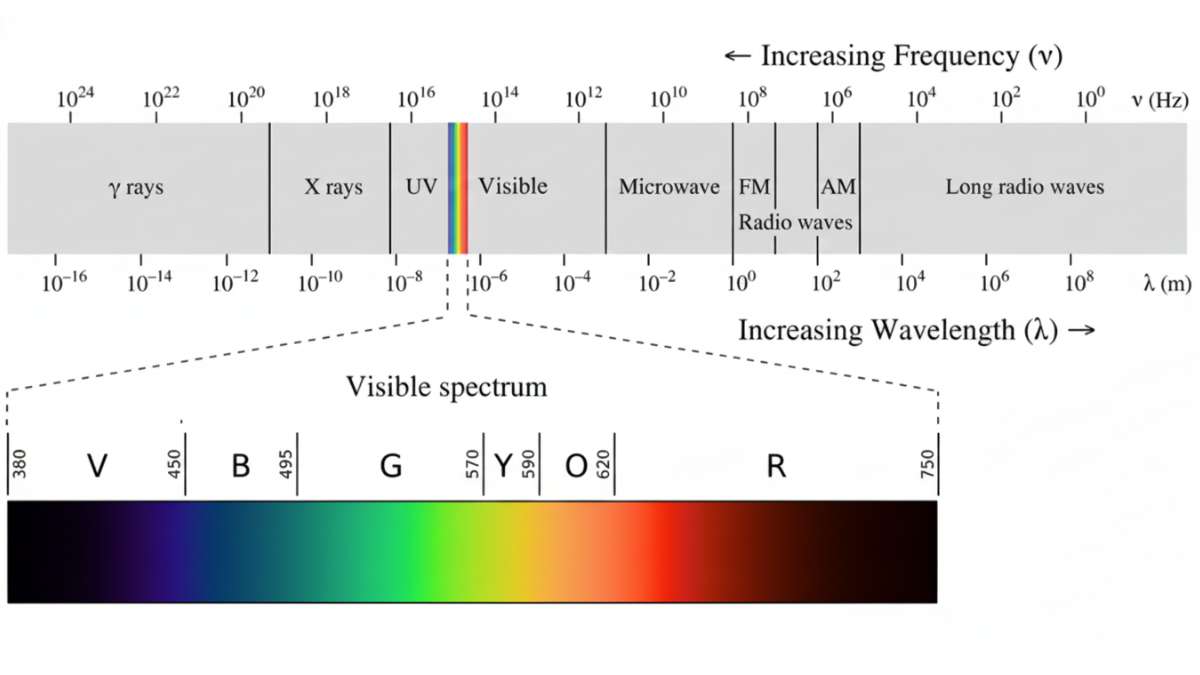
(Credit: Commons.Wikimedia.org )
Here’s a simple table to make it easy to see:
| Color | Approximate Wavelength (nm) | Fun Description | Everyday Example |
|---|---|---|---|
| Red | 620–750 | Warm and bold, like a stop sign | Apples, fire trucks |
| Orange | 590–620 | Energetic and fun, like citrus fruits | Oranges, carrots |
| Yellow | 570–590 | Bright and cheerful, like sunshine | Bananas, lemons |
| Green | 495–570 | Fresh and calming, like grass | Leaves, emeralds |
| Blue | 450–495 | Cool and peaceful, like the ocean | Sky, blueberries |
| Indigo | 420–450 | Deep and mysterious (a mix of blue and violet) | Midnight sky |
| Violet | 380–420 | Rich and creative, like grapes | Lavender flowers |
Many kids learn the order with memory trick (mnemonics) like “Richard Of York Gave Battle In Vain” or just “ROY G. BIV.” Some people argue there are only six colors because indigo is hard to distinguish from blue. That’s a fair point, it is s more of a tradition than a strict rule.
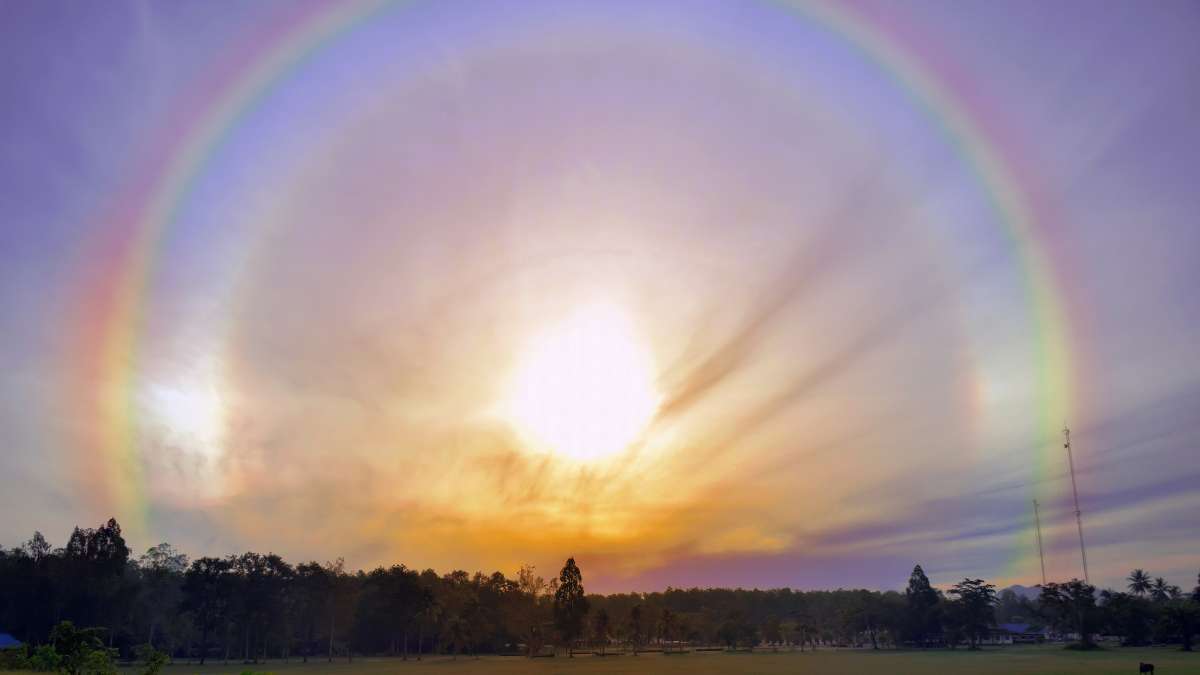
Fun fact: The rainbow is actually a full circle! We usually see just an arc because the ground blocks the bottom half. From an airplane or mountain, you might spot a complete circle rainbow.
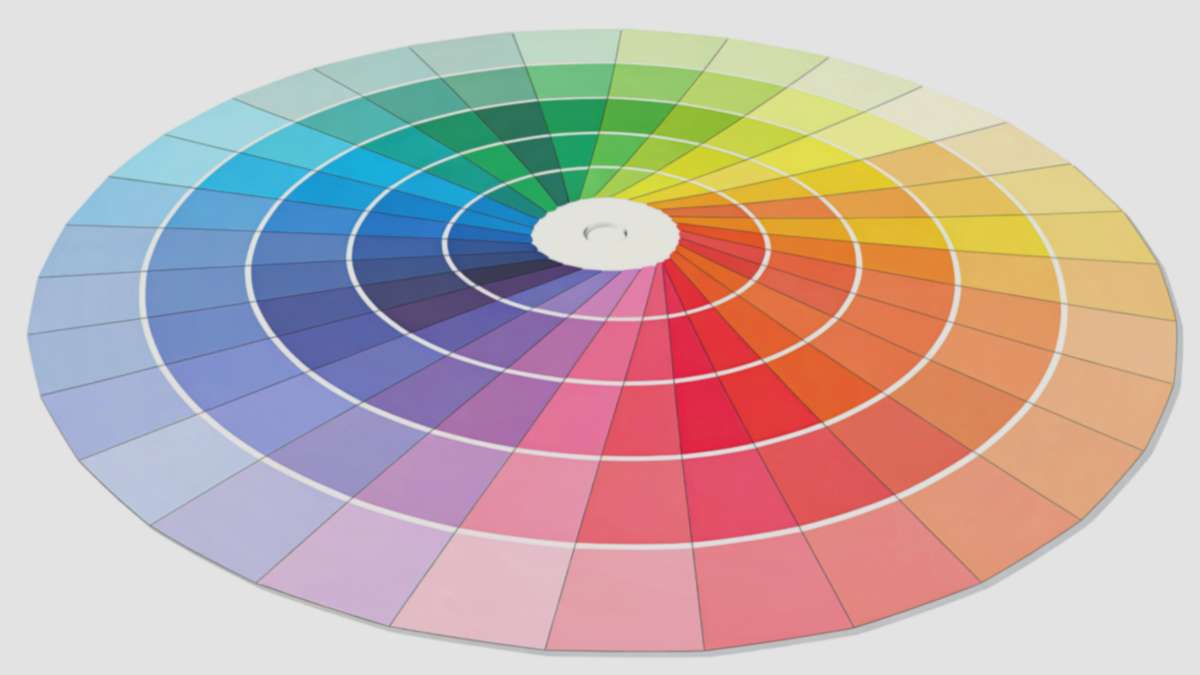
AI Prompt Ideas for Visuals Here:
a) Create a soft gradient background blending all rainbow hues seamlessly. Great for showing how colors flow into each other.
b) Produce a clean, minimalist rainbow gradient suitable for branding. Simple and modern for infographics.
c) Generate a rainbow-colored prism effect spreading across a dark background. Perfect to illustrate the spectrum.
The Science Behind Rainbow Colors: How Rainbows Form
Okay, time for the cool science part, which is how do these beautiful rainbow colors actually appear in the sky?
It all starts with three simple things: sunlight, raindrops, and you (the observer).
Sunlight is “white” light, but it is packed with all the colors of the rainbow. When the sun shines on raindrops in the air (usually right after a shower), the light enters each tiny drop. Inside the drop, something amazing happens:
1) Refraction: The light bends as it enters the water (because light slows down in water).
2) Dispersion: The different colors bend by different amounts, with red bending the least, violet bends the most, so they spread out.
3) Reflection: The light bounces off the back of the raindrop.
4) Refraction again: It bends once more as it leaves the drop.
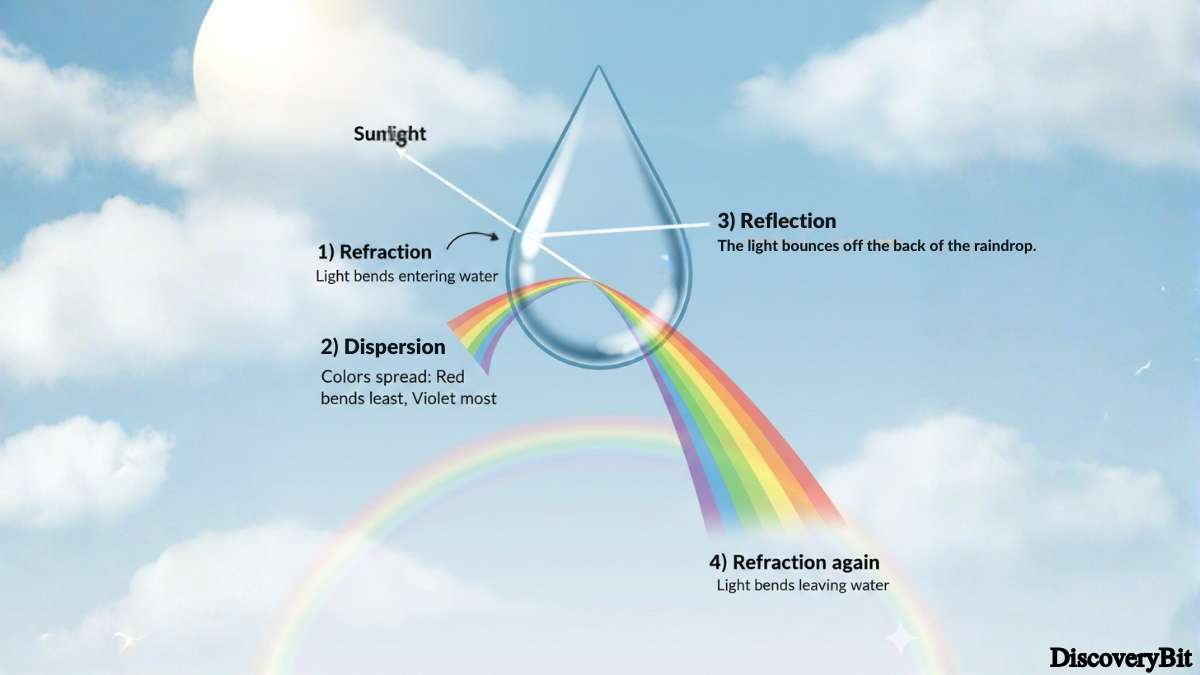
All these steps together send the separated colors toward your eyes at just the right angle. You see the rainbow about 42 degrees from the direction opposite the sun (and that is why rainbows appear when the sun is behind you).
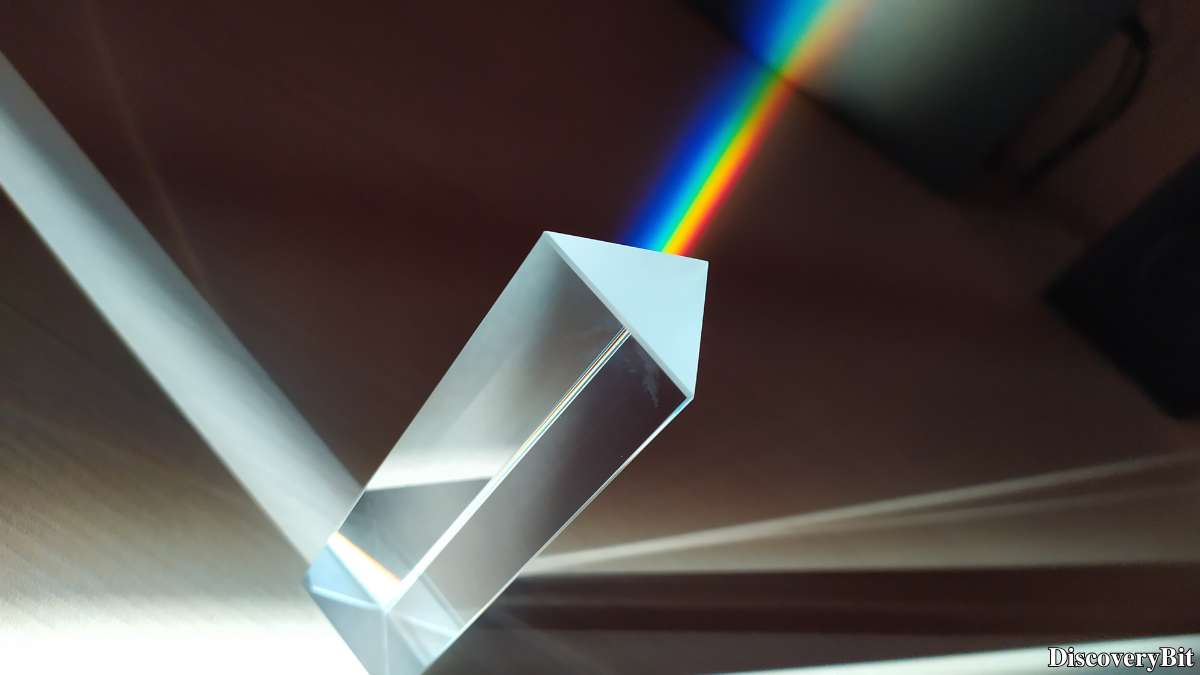
The famous scientist Isaac Newton figured this out in the 1600s by shining light through glass prisms in his room. He proved that white light is made of colors, and not the other way around (Newton, 1704).
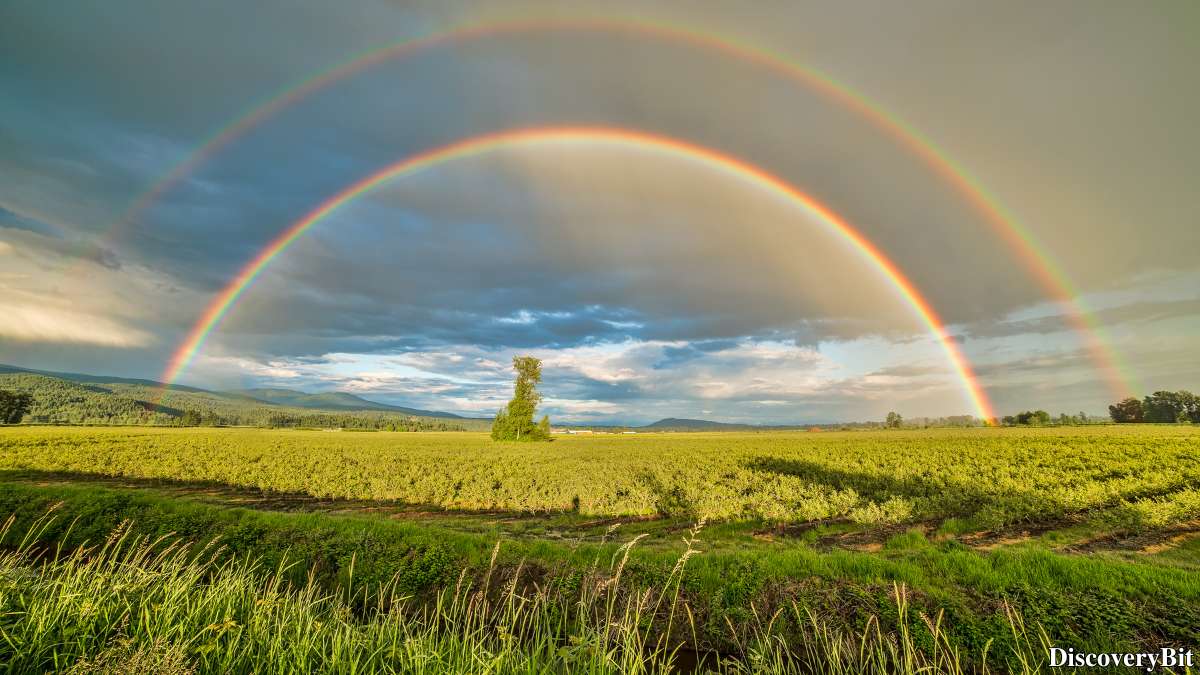
For a double rainbow, some light bounces twice inside the drop, creating a fainter second arc with colors that are reversed (violet on the outside).
Other factors: Rainbows are brightest when the sun is low in the sky, and you need millions of raindrops acting like tiny prisms.
Simple Home Project
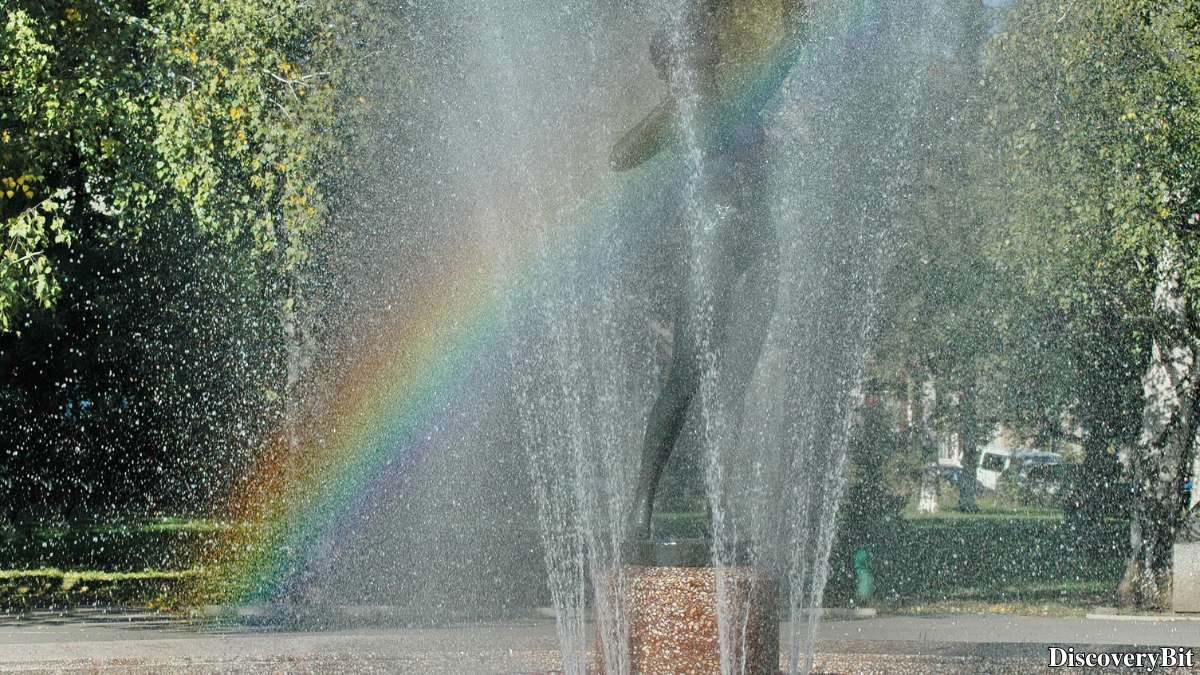
You can make your own mini rainbow at home! On a sunny day, stand with your back to the sun and spray water from a garden hose into the air. Watch the mist, and boom, a rainbow!
AI Prompt Ideas for Science Visuals:
a) Design a vibrant rainbow-colored light burst for a modern visual effect, to show light exploding into colors.
b) Generate a glowing rainbow-color wave pattern with a futuristic feel, for explaining wavelengths.
Historical Evolution of Rainbow Colors
People have wondered about rainbows forever, but how we see the colors has changed over time.
Ancient thinkers like Aristotle (around 350 BCE) thought rainbows had just three main colors: red, green, and violet. They tied them to ideas about the elements (fire, earth, water).
Fast forward to the 1600s. Isaac Newton did his famous prism experiments and decided on seven colors. Why seven? He wanted to match the seven notes in a musical scale and believed in the “magic” number seven (Newton, 1730 edition of *Opticks*). Before him, many people saw only five colors.
After Newton, seven became the standard in books and schools. But in some cultures, people group colors differently. For example, some languages don’t have separate words for blue and green, as they see them as shades of one color.
Today, scientists know the spectrum is continuous (no sharp lines between colors), but we still teach seven for tradition and ease.
AI Prompt Idea:
a) Create a rainbow-inspired texture that looks hand-painted and organic, to give a historical, artistic feel.
Variations and Types of Rainbows: Beyond the Basics
Not all rainbows look the same! Here are some rare and cool types:
1) Double Rainbows

A double rainbow occurs when light reflects twice inside water droplets. This second reflection causes the outer arc to appear fainter and results in a reversed color sequence (red on the inside, violet on the outside). The space between the two arcs is known as Alexander’s band, which appears noticeably darker than the surrounding sky (Nussenzveig, 1977; Lee & Fraser, 2001).
2) Moonbows (Lunar Rainbows)

Moonbows are rare phenomena produced by moonlight rather than direct sunlight. They require a bright, near-full moon positioned low in the sky against a dark, rainy backdrop. Because moonlight is significantly weaker, moonbows often appear white or ghostly to the human eye, as the light is too faint to trigger our color-detecting cone cells (Cowley, n.d.; Minnaert, 1954).
3) Fogbows

(Credit: Treehugger.com)
Created by the tiny water droplets in fog or mist, which are much smaller than raindrops, fogbows lack vibrant colors. Due to the diffraction of light in these minute droplets, the colors overlap and wash out, resulting in a broad, brilliant white arc. They are often nicknamed “ghost rainbows” or “white rainbows” for their ethereal appearance (Cowley, n.d.; Greenler, 1980).
4) Supernumerary Rainbows
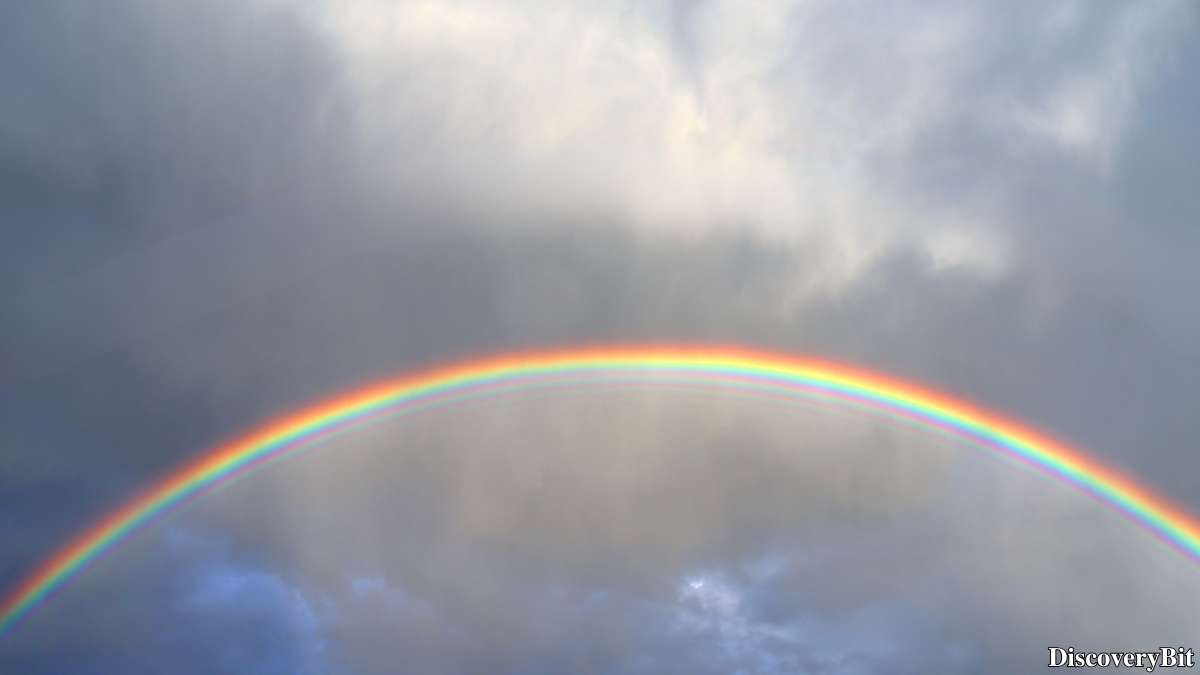
These consist of several faint, thin bands (usually green, pink, or purple) located just inside the primary rainbow’s inner edge. They are caused by light wave interference. When raindrops are small and uniform in size, the light waves overlapping within them either cancel out or reinforce one another, creating these delicate, fringe-like repetitions (Airy, 1838; Laven, 2004).
5) Fire Rainbows (Circumhorizontal Arcs)

Despite the name, these have nothing to do with fire or rain. They are large, colorful halos that form when sunlight hits hexagonal ice crystals in high-altitude cirrus clouds. The sun must be very high in the sky (above 58°). The light enters the vertical side of the crystal and exits the bottom, creating a vivid, flat spectrum (Cowley, n.d.; Tape & Moelman, 2006).
6) Red Rainbows (Monochrome Rainbows)

(Credit: Wikimedia.org )
During sunrise or sunset, sunlight must travel through a much thicker layer of the Earth’s atmosphere. This scatters away shorter wavelengths (blue and green), leaving only the long-wavelength reds and oranges. When this filtered light hits raindrops, it produces a dramatic, purely red arc that can look quite otherworldly against a darkening sky (Cowley, n.d.; Minnaert, 1954).
7) Twinned Rainbows
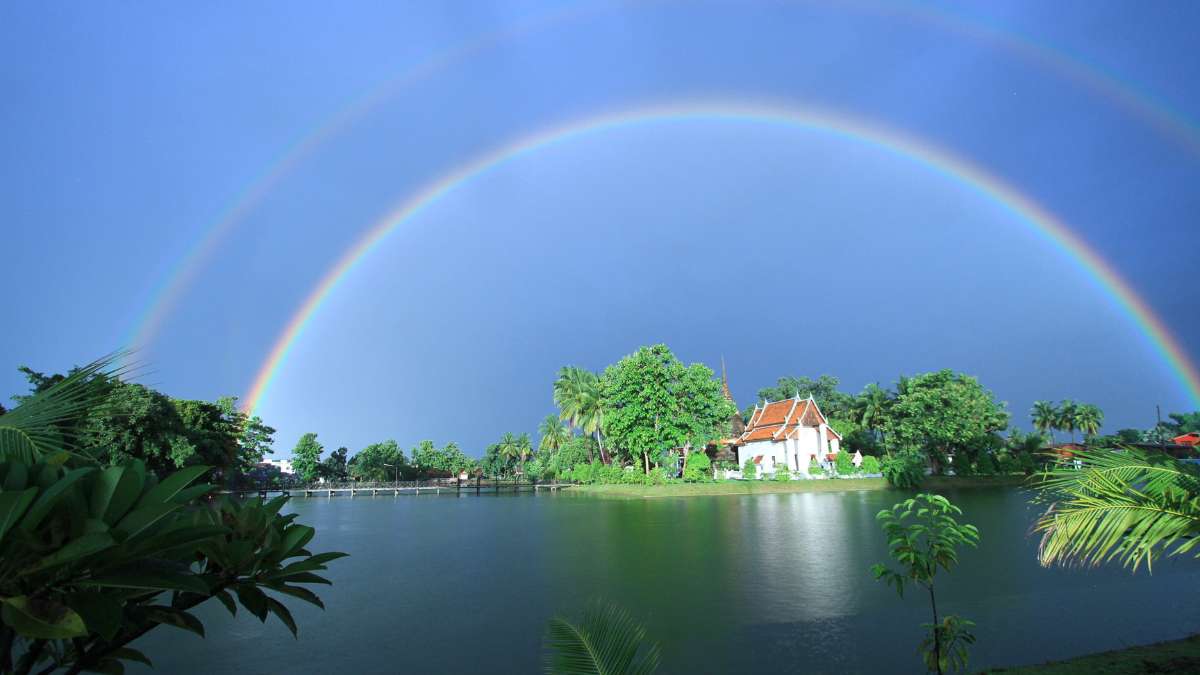
Twinned rainbows are exceptionally rare and involve two distinct arcs that originate from a single base. This happens when a rain shower contains a mix of different droplet shapes and sizes. Typically, a combination of spherical droplets and slightly flattened “oblate” drops causes the light to refract at different angles, splitting the rainbow into two (Sadeghi et al., 2012; Cowley, n.d.).
Even on other planets, like Saturn’s moon Titan, scientists think there could be methane rainbows.
AI Prompt Ideas for Rare Rainbows:
A) Produce a dreamy scene with misty rainbow colors drifting through the air, for fogbows or moonbows.
B) Create a luminous rainbow halo effect for a magical atmosphere. Perfect for fire rainbows.
Colors Not in the Rainbow: What’s Missing and Why
You might wonder: Why no pink, brown, or black in rainbows?
Rainbow colors are “spectral,” which are pure single wavelengths. Colors like pink (red mixed with white), brown (dark orange), or gray are mixes or lower brightness. Black and white aren’t colors in the spectrum at all. White is all colors together, black is none.
Our eyes see color with three types of cones (red, green, blue sensitive). That’s why screens mix RGB to make millions of shades.
Cultural, Mythological, and Symbolic Significance of Rainbow Colors
Rainbows mean different things around the world:
a) Biblical Symbolism
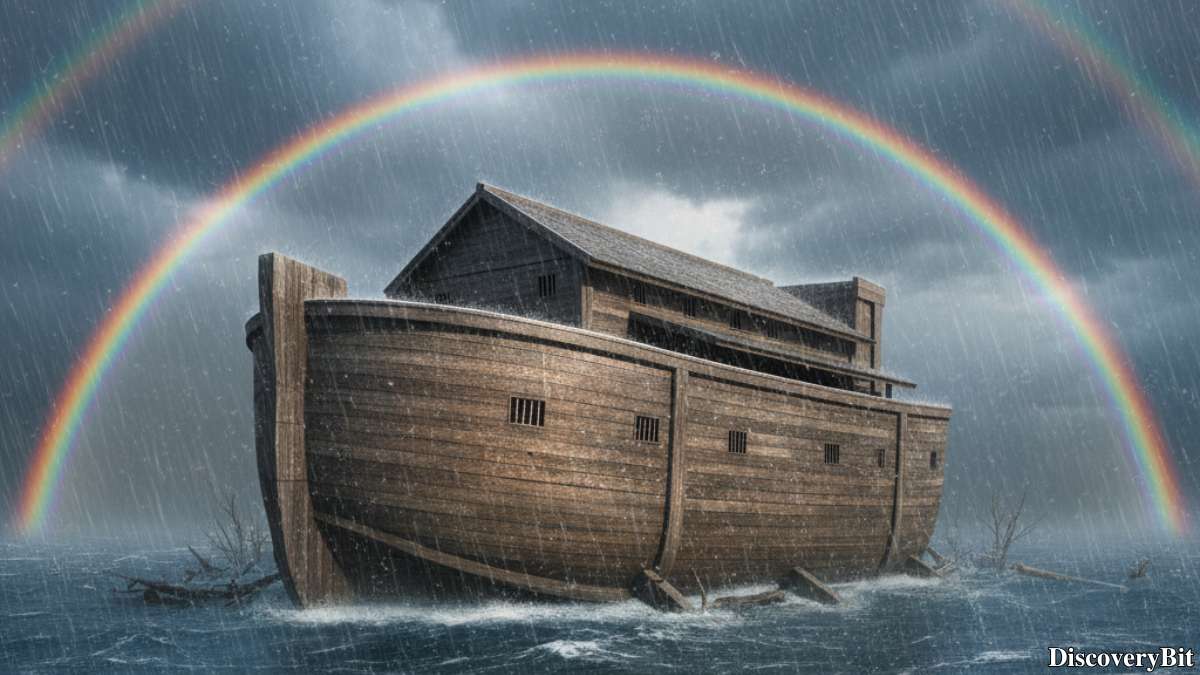
In the Book of Genesis, the rainbow is established as a covenant between God and all living creatures.
Genesis 9:13 (NKJV): “I set My rainbow in the cloud, and it shall be for the sign of the covenant between Me and the earth.”
Appearing after the Great Flood, it serves as a divine promise that a global flood will never again destroy the Earth. It represents mercy, grace, and the restoration of order after a period of judgment (Sarna, 1989).
b) Norse Mythology: The Bifröst
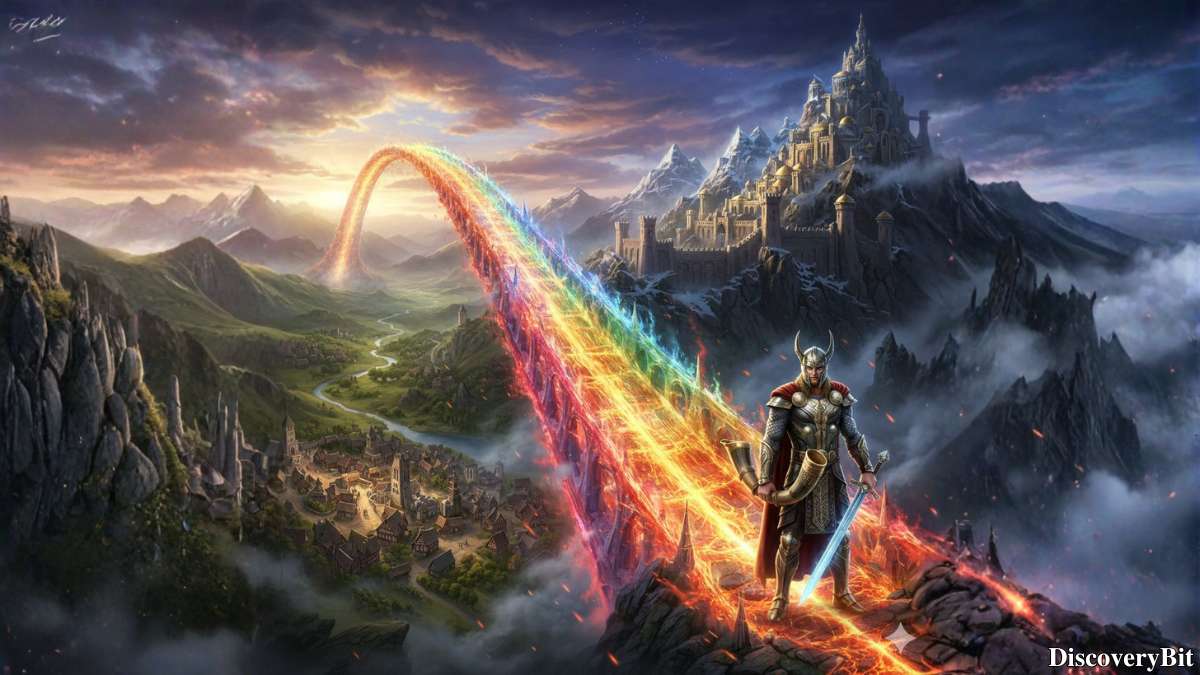
Norse myths describe the rainbow as Bifröst, a shimmering “Burning Rainbow Bridge” connecting Midgard (the world of humans) to Asgard (the realm of the gods). Guarded by the god Heimdall, the bridge is said to be incredibly strong but will eventually shatter during the events of Ragnarök under the weight of giants (Sturluson, 1220).
c) Irish Folklore: Pot of Gold
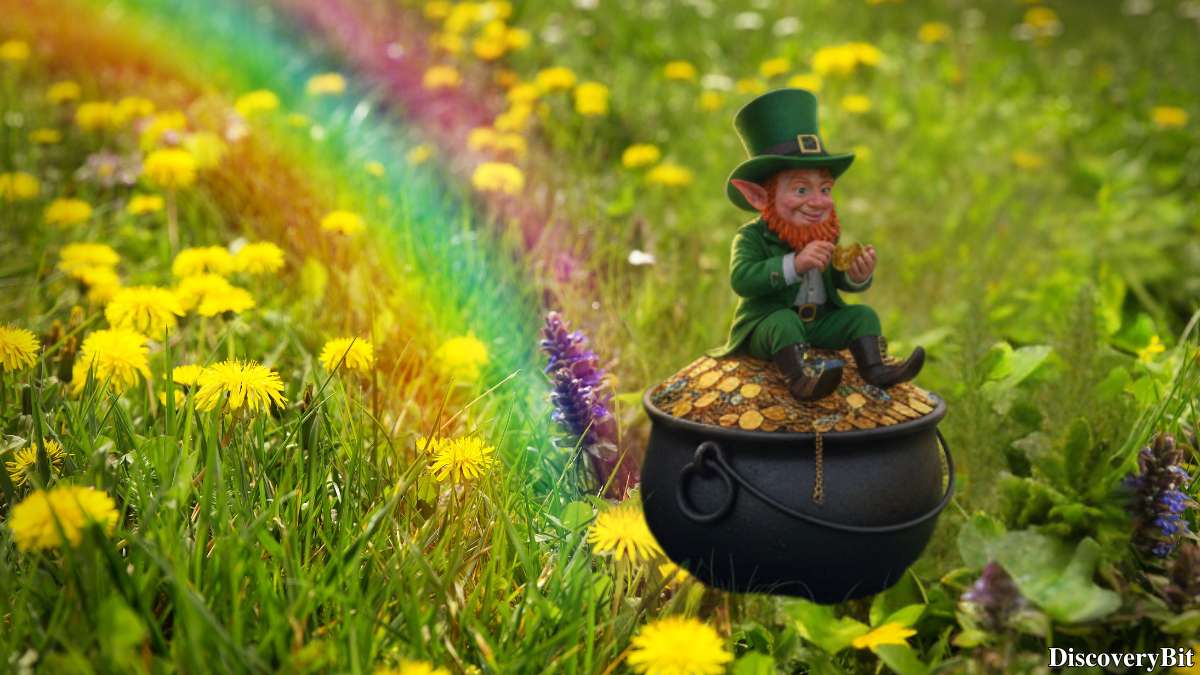
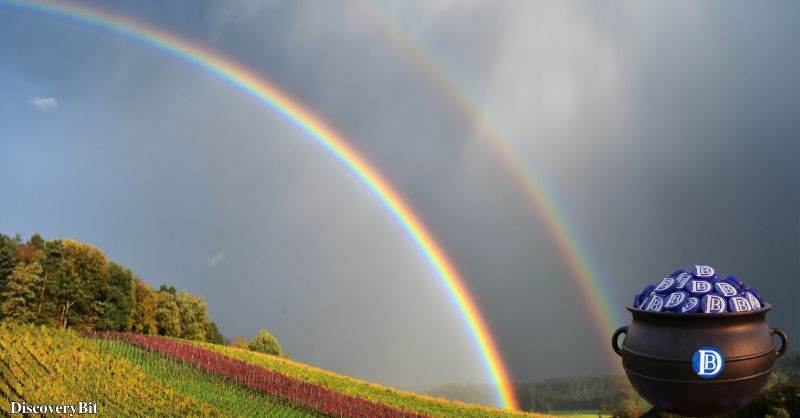
Popular Irish legend claims leprechauns hide their pots of gold at the end of a rainbow. However, because a rainbow is an optical phenomenon, and not a physical object, the “end” moves as the observer moves (Lee & Fraser, 2001). This makes the treasure eternally unreachable, symbolizing both elusive fortune and the trickery of the fae.
d) Universal Hope and Peace
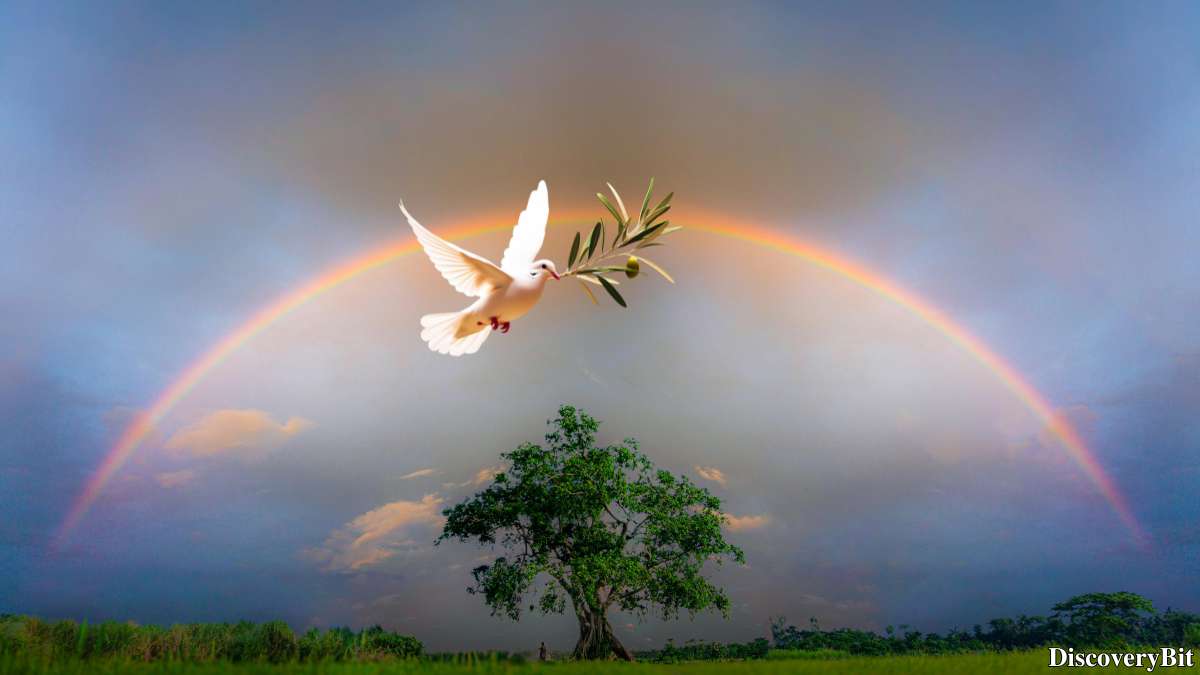
Across many cultures, the rainbow serves as a universal bridge or a sign of harmony. From the “Rainbow Snake” of Australian Aboriginal Dreamtime to modern symbols of social inclusion, the spectrum of light represents the beauty of diversity and the calming of a storm, signaling that peace has returned (Reed, 1999).
e) The Pride Flag

Created by artist Gilbert Baker for the 1978 San Francisco Gay Freedom Day Parade, the flag was designed as a “natural” symbol of hope to replace the pink triangle (Baker, 2019). Originally, it featured eight colors, each with a specific meaning: hot pink (sex), red (life), orange (healing), yellow (sun), green (nature), turquoise (art), indigo (serenity), and violet (spirit).
AI Prompt Idea:
Visualize creativity as an explosion of rainbow colors in motion. For cultural inspiration.
Applications of Rainbow Colors in Design, Art, and Everyday Life
Rainbow colors pop up everywhere in design because they are eye-catching and positive.
A) Color Psychology: Red grabs attention and feels exciting; blue calms and builds trust (Elliot & Maier, 2014). Brands use rainbows for fun, inclusivity, or energy. Branding Examples: Think Skittles (“Taste the Rainbow”), Google logo, or Pride collections.
B) Art & Fashion: Artists love gradients; fashion has rainbow trends every few years.
C) Digital Design: Websites use rainbow accents for buttons or loading animations.
d) Everyday: Fiber optic cables use spectrum colors; therapy lights for mood.
Tips for you: Pair opposite colors (like red and green) for contrast, or use soft pastels for calm vibes.
More AI Prompt Ideas for Design Sections:
a) Render a metallic object reflecting rainbow colors across its surface.
b) Generate a rainbow-color smoke effect with smooth, flowing movement.
c) Create a bold rainbow streak across a black canvas for dramatic contrast.
d) Render a glossy, liquid-rainbow texture with high detail.
e) Generate a rainbow-inspired abstract background for digital art.
f) Create a soft pastel rainbow palette for a calming, aesthetic mood.
g) Render a dynamic splash of rainbow paint frozen in mid-air.
h) Generate a rainbow-light reflection on glass for a photography-style effect.
i) Create a vibrant rainbow nebula swirling in deep space.
j) Produce a geometric pattern filled with shifting rainbow tones.
These prompts are great for creating custom images to spice up any blog post/article!
Common Myths and Facts About Rainbow Colors
Myth 1: There is a pot of gold at the end.
Fact: Rainbows are circles with no “end.” It is an optical trick.
Myth 2: Rainbows have exactly seven colors.
Fact: It is a smooth blend; seven is just how we teach it.
Myth 3: You can touch a rainbow.
Fact: It moves as you move, depending on your viewpoint.
Random Fun Fact: Some animals (like birds) see more colors than us; others (dogs) see fewer.
FAQs About Rainbow Colors
1) What is the order of rainbow colors?
Ans: Red, orange, yellow, green, blue, indigo, violet (ROYGBIV).
2) How many colors are in a rainbow?
Ans: Technically infinite, as it is a continuous spectrum. We say seven for simplicity.
3) Why seven rainbow colors?
Ans: Thanks to Isaac Newton linking them to music notes (Newton, 1730).
4) Can you see rainbows at night?
Ans: Yes! Moonbows from bright moonlight.
5) What causes double rainbows?
Ans: Light reflecting twice inside droplets; colors reverse in the second.
6) Are rainbow colors the same in every culture?
Ans: The physics is, but how people name or group them varies.
7) Why no pink in rainbows?
Ans: Pink isn’t a pure wavelength, as it is red plus white.
8) How can I make a rainbow at home?
Ans: Use a prism, CD, or hose spray on a sunny day.
9) Do rainbows appear on other planets?
Ans: Possibly, because scientists predict them on worlds with atmospheres and liquids.
10) What’s the rarest rainbow type?
Ans: Supernumerary or twinned, because they are hard to spot!
Conclusion
Rainbow colors are more than pretty, they connect science, history, culture, and creativity. From Newton’s prisms to pride flags, they have inspired us forever.
Next sunny shower, look up! You might catch one! Or try making your own rainbow colors with a hose. Use the AI prompts scattered in this post to generate awesome visuals for your own projects.
What’s your favorite rainbow memory?
References
- Newton, I. (1704).Opticks: Or, A Treatise of the Reflexions, Refractions, Inflexions and Colours of Light. London: Sam. Smith and Benj. Walford. (This is the original publication where Newton first detailed his prism experiments and the separation of white light into spectral colors.)
- Newton, I. (1730).Opticks (4th edition). London: William Innys. (Later edition where Newton more explicitly discussed his choice of seven colors, linking them to musical intervals and the “magic of seven.”)
- Aristotle (c. 350 BCE).Meteorologica. (Ancient Greek text where Aristotle described rainbows as having primarily three colors: red, green, and violet, tied to his theory of elements.)
- Elliot, A. J., & Maier, M. A. (2014). Color psychology: Effects of perceiving color on psychological functioning in humans. Annual Review of Psychology, 65, 95–120. (A key modern review paper on how colors like those in the rainbow influence emotions, attention, and behavior—used for the color psychology section.)
- Airy, G. B. (1838). On the intensity of light in the neighbourhood of a caustic. Transactions of the Cambridge Philosophical Society, 6, 379–402. (Classic explanation of interference fringes in supernumerary rainbows.)
- Cowley, L. (n.d.). Atmospheric Optics website (atoptics.co.uk). (Comprehensive resource with detailed explanations, simulations, and images of all listed rainbow variations; continuously updated.)
- Greenler, R. (1980). Rainbows, Halos, and Glories. Cambridge University Press. (Excellent illustrated book on atmospheric optical phenomena, including fogbows and other variations.)
- Laven, P. (2004). Simulation of rainbows, coronas and glories using Mie theory and the Debye series. Journal of Quantitative Spectroscopy and Radiative Transfer, 89, 257–269. (Modern computational treatment of rainbow phenomena.)
- Lee, R. L., & Fraser, A. B. (2001). The Rainbow Bridge: Rainbows in Art, Myth, and Science. Pennsylvania State University Press. (In-depth coverage of double rainbows, Alexander’s band, and cultural/scientific history.)
- Minnaert, M. (1954). The Nature of Light and Colour in the Open Air. Dover Publications. (Timeless classic discussing moonbows, red rainbows, and many optical effects.)
- Nussenzveig, H. M. (1977). The theory of the rainbow. Scientific American, 236(4), 116–127. (Detailed physical explanation of primary and secondary rainbows.)
- Sadeghi, I., et al. (2012). Physically-based simulation of rainbows. ACM Transactions on Graphics, 31(1), Article 3. (Scientific paper explaining the mechanism behind twinned rainbows through simulations.)
- Tape, W., & Moelman, J. (2006). Atmospheric Halos. American Geophysical Union. (Authoritative reference on ice crystal halos, including circumhorizontal arcs.)
Baker, G. (2019). Rainbow Warrior: My Life in Color. Chicago Review Press.
Bible. The Holy Bible, New King James Version (NKJV). Thomas Nelson.
Lee, R. L., & Fraser, A. B. (2001). The Rainbow Bridge: Rainbows in Art, Myth, and Science. Pennsylvania State University Press.
Reed, A. W. (1999). Aboriginal Myths, Legends and Fables. Reed New Holland.
Sarna, N. M. (1989). The JPS Torah Commentary: Genesis. Jewish Publication Society.
Sturluson, S. (1220). The Prose Edda. (Translated by Anthony Faulkes, 1987).